Musty smell from vents in Warren, MI

One request and the duct cleaning stops waiting on you.

I'm done searching

A musty smell from your vents usually means moisture sitting somewhere in the duct system, and in Warren that often traces back to the air conditioner. The AC coil pulls humidity out of the air all summer, and that water needs to drain away. If the drain line is clogged or the coil stays wet between cycles, mold and mildew start growing right where the air passes, and your blower pushes that smell into every room. A dirty filter makes it worse by slowing airflow and letting moisture linger longer than it should. Sometimes the smell comes from the ducts themselves, especially if dust has built up enough to hold moisture after a humid stretch. None of this is an emergency, but it will not go away on its own, and it tends to come back stronger each time the AC runs. A cleaning gets at the actual source instead of just covering the smell for a few days.

Unfinished basement with bare concrete floor and walls, exposed wood joists, large galvanized sheet-metal ductwork, PVC and copper piping, and a gray furnace unit beside wood stud framing.

Ducts running clean

Here the ductwork sits dry and clear, so air moves through without picking up odor. The coil drains the way it should, and the metal stays free of standing water. Run the furnace fan with no AC on and the air coming out should smell like nothing at all.

Basement ceiling with large galvanized sheet-metal ductwork, round metal pipes and plumbing lines running beneath wood joists, above a bare concrete wall and floor.

Moisture sitting in the ducts

Water staining on the foundation wall points to moisture that has worked its way into the duct run above it. Sheet metal that stays damp breeds the smell you're catching at the vents. Once that moisture sits long enough, it keeps feeding the odor even after the humidity outside drops.

Coil Smell or Duct Smell

Musty smell from the coil

  • The coil sits wet most of the summer, and a drain line that's slow or clogged leaves water sitting in the pan under it.
  • Standing water in a dark duct system grows mold, and that smell rides the air every time the fan runs.
  • Running the fan with the AC off is a quick check: if the smell is strongest right after the compressor shuts off, the coil is where to look.
  • A contractor can clean the coil and clear the drain line, and in a lot of cases that's the whole fix.
  • If the pan has rusted through or the coil is damaged, cleaning won't hold and the smell comes back within a season.

Musty smell from the ducts

  • If the smell shows up no matter the season, heat on or AC on, the moisture is more likely sitting in the ductwork itself.
  • Ducts that run through a crawlspace or an unconditioned part of the house pick up moisture from the air around them, not just from the coil.
  • Dust and debris built up inside the ducts holds onto that moisture, and that combination is what makes the smell linger.
  • A full duct cleaning clears out what's built up along the way, not just at one point near the unit.
  • If the ducts have a leak drawing in outside air, cleaning helps for a while but the smell can return until that leak gets found.
Galvanized sheet metal HVAC ductwork and round pipes running along an exposed wood-joist basement ceiling beside a plain white wall.

Why the smell comes back in summer

The coil sheds water as long as the air conditioner runs, and in Warren that's April through October most years. That drain line slopes to carry the water out, and even a small clog slows it enough to leave a film in the pan. Mold needs almost nothing to grow on, just that dampness and the dark inside the plenum. Shut the AC off and the coil dries out, so the smell often fades some by winter, then picks back up once the system starts cycling again.

Galvanized sheet metal HVAC ducts and round pipes installed among wooden joists on a ceiling, beside a large blank white wall.

What a cleaning actually removes

A contractor cleaning the system runs a brush or vacuum head through each duct run, pulling out the dust and debris that mold has been feeding on, then checks the coil and drain pan directly rather than guessing from the smell alone. If the drain line is the cause, clearing it stops new water from collecting. Filters get swapped too, since a loaded filter holds the same moisture and dust the ducts do. None of that depends on the ductwork's age, only on what's sitting in it now.

Why does this keep coming back year after year?

  • Half the homes here were built by 1975

    Half the homes in Macomb County were built in 1975 or earlier, and ductwork that old has had decades to collect the dust and film that odor clings to.

  • Heat runs October through May

    Cooling runs June through August here, and that's three straight months of the coil draining condensate into ducts that may not dry out between runs.

  • Cooling runs June through August

    Heat runs October through May, so for eight months the system rarely moves outside air through those same ducts, giving any smell time to settle in.

ACS 2020-2024 · NOAA nClimDiv 1991-2020

Empty basement with bare concrete walls and floor, a small window at left, and exposed wood joists with galvanized sheet metal ductwork and pipes overhead.
Clean metal, no film anywhere the air passes, in a basement that still smells like concrete.
Dusty sheet-metal HVAC ducts with a rectangular vent register run beneath wooden floor joists above an empty concrete-walled basement.
Dark grime coats the duct and the pipe beside it, and every cubic foot of air brushes past it first.

Why does running the fan make the musty smell worse?

You turn the fan on hoping to clear the air out, and instead the smell gets stronger right away. It feels backwards, like the fan is pulling the odor out of somewhere instead of blowing it away. That reaction usually means the moisture causing the smell is sitting right where the air has to pass.

The fan pushes air straight across the wet spot

Air handlers pull return air across the coil and through the duct before it reaches your rooms. If water is sitting in the drain pan or a film has built up on the coil or the duct walls, every bit of air moving through has to pass right over it. A fan that's off leaves that smell sitting still. Turn it on and you're moving air directly across the source, carrying it into every room the system serves. This is why the smell seems to come and go with the system running rather than staying constant. It also means the odor isn't coming from the room you're standing in. It's coming from the equipment, and the fan is just the thing proving it.

A smiling bearded man in a blue-gray t-shirt sits on a gray couch in a living room with wooden shelving and a bright window behind him, looking down toward a device at the lower edge of the frame.
A bearded man in a dark plaid flannel shirt stands indoors looking out a window at a snow-covered yard, with a dark gray mug on the windowsill and kitchen shelves behind him.

One request and it's handed off

The pro who gets in touch is licensed in Michigan and works in Macomb County.

It costs nothing to send, and you don't have to hire anyone.

  1. Warm moist air passes over the cold AC coil

  2. The coil pulls water out of the air

  3. Water drips into the drain pan below the coil

  4. A clogged drain line lets water back up into the pan

Why does my house smell musty every time the air kicks on

You notice it most when you walk into a room right after the AC cycles on, or when you come home after being out for the day with the house closed up. It's not strong like garbage or mildew in a bathroom. It's faint, a little damp, a little stale, and it fades if you air the place out for a bit, then comes right back once the system runs again. Some rooms carry it worse than others, usually the ones farthest from the furnace or closest to the basement ductwork. Left alone through another summer of humidity, that moisture keeps feeding whatever is growing in there, and the people in the house end up breathing it every time the fan turns on.

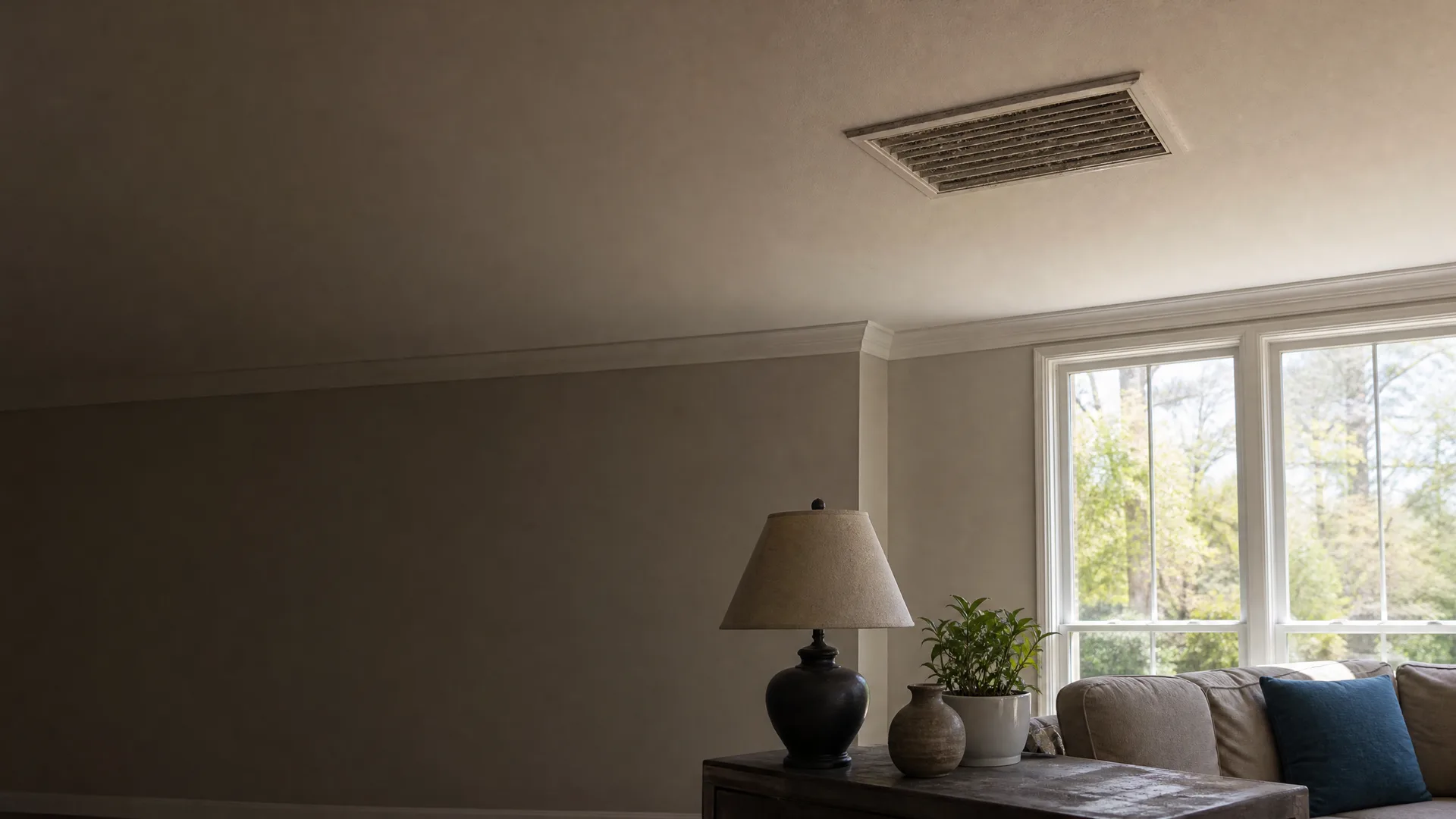
A ceiling air vent in a living room with beige walls, a table lamp and potted plant on a wooden console, a sofa with a blue cushion, and a window showing green trees outside.

It's late April, and you finally turn the furnace off for the season. Sun's coming in through the living room window, warm enough that you notice the house feels stale underneath it. You look up at the ceiling vent and the grille is gray with dust, more than you remembered. The end table under it and the lamp base have the same gray film sitting on them, the kind that comes back a few days after you wipe it. You run a finger along the vent slats and it comes away dark. The room looks clean otherwise. It's just that one patch of air, falling down out of the ceiling, settling on everything underneath it all winter.


Power here costs 20.25 cents per kilowatt-hour

At 20.25 cents per kilowatt-hour, running the furnace fan around the clock to chase a musty smell adds up fast on your bill. Clearing the moisture at the source, in the ductwork and drain line, fixes the smell without leaning on the fan to do it.

EIA-861 2025

Dealing with it yourself

You can run the fan more, run a dehumidifier in the basement, or swap the filter again and hope the smell fades. Sometimes it helps for a few days. But if the water is sitting in the drain pan or the duct metal has film built up on it, none of that touches the source. You're back to noticing it the next time the AC cycles on, and you're spending time on something that didn't fix the actual problem.

Having the ducts cleaned

A contractor who works on duct systems in Macomb County every summer knows where water tends to sit and what that film looks like once it's built up. Cleaning clears the duct and checks the drain line so water moves the way it's supposed to. It's one visit instead of a season of guessing, and you get an answer about what was actually causing the smell instead of just hoping it stays away.

Galvanized sheet metal HVAC ductwork with a vent grille running along a wooden joist ceiling above a bare concrete wall.
Before you get your ductwork cleaning
A basement with a gray furnace on a concrete pad connected to large sheet-metal ducts running along an exposed wood joist ceiling, with PVC pipes and plastic sheeting on the walls.
After you get your ductwork cleaning

Where the smell starts and stops

  • A musty smell from your vents means moisture is sitting in the duct system, usually traced back to the AC coil and its drain line.
  • A slow or clogged drain line lets water back up into the pan under the coil instead of draining away.
  • Standing water in a dark duct system grows mold, and that smell rides the air every time the fan runs.
  • Running the fan more or swapping the filter can mask the smell for a few days, but it comes back if the moisture is still there.
  • Cleaning the ductwork and clearing the drain line fixes the smell at the source instead of just moving air around it.
  • Once the coil, pan and ducts are clean and draining properly, the air coming through the vents should run clear through next summer.

You came here with a musty smell and a reasonable guess that it's the vents. It is, but not because the ductwork itself is the problem. The air conditioner's coil is wet most of a Warren summer, and that water has one way out: the drain line. When that line slows down or clogs, water backs up into the pan under the coil and sits there. Metal ductwork doesn't dry out fast in a basement, so that standing water turns into a film, and mold takes hold in it. Every time the fan kicks on, that air moves through the duct and picks up the smell on its way to the room you're standing in. That's the whole chain. It's why running the fan harder doesn't help. It's pulling air across the same wet, moldy metal, just more of it. A new filter or a dehumidifier running in the basement can take the edge off for a few days, but neither one touches the water sitting in the pan or the film built up in the duct. The smell comes back because the source never left. Clearing the drain line and cleaning the coil, pan and ductwork gets rid of what's actually growing in there, not just the air carrying its smell. Once that's done, the fan running on a July afternoon shouldn't bring the smell with it, straight through next summer's heat.

A smiling man in a dark olive long-sleeve shirt sits in a kitchen beside a counter with a dark mug, with a dining table, sideboard and hallway visible in the blurred background.
A smiling bearded man in a navy sweater sits at a white kitchen island with a ceramic mug, with open shelves, potted plants and a range hood behind him.
A smiling bearded man in a grey long-sleeved shirt sits at a kitchen counter with a dark mug, with a dining table, pendant light and glass doors onto greenery behind him.
A smiling man in a blue denim shirt over a white tee sits at a light stone kitchen counter with a grey mug and a bowl of oranges and bananas, with pendant lights and shelving behind him.

Ductwork Cleaning

Done looking for a duct system pro

A licensed pro who works in Macomb County gets your request.

A black-framed smartphone standing upright against a plain light gray background, its screen filled with solid green.
Duct and vent cleaningDucts or ventsMacomb County, MI
Step 1 of 2

What ZIP code is the job in?