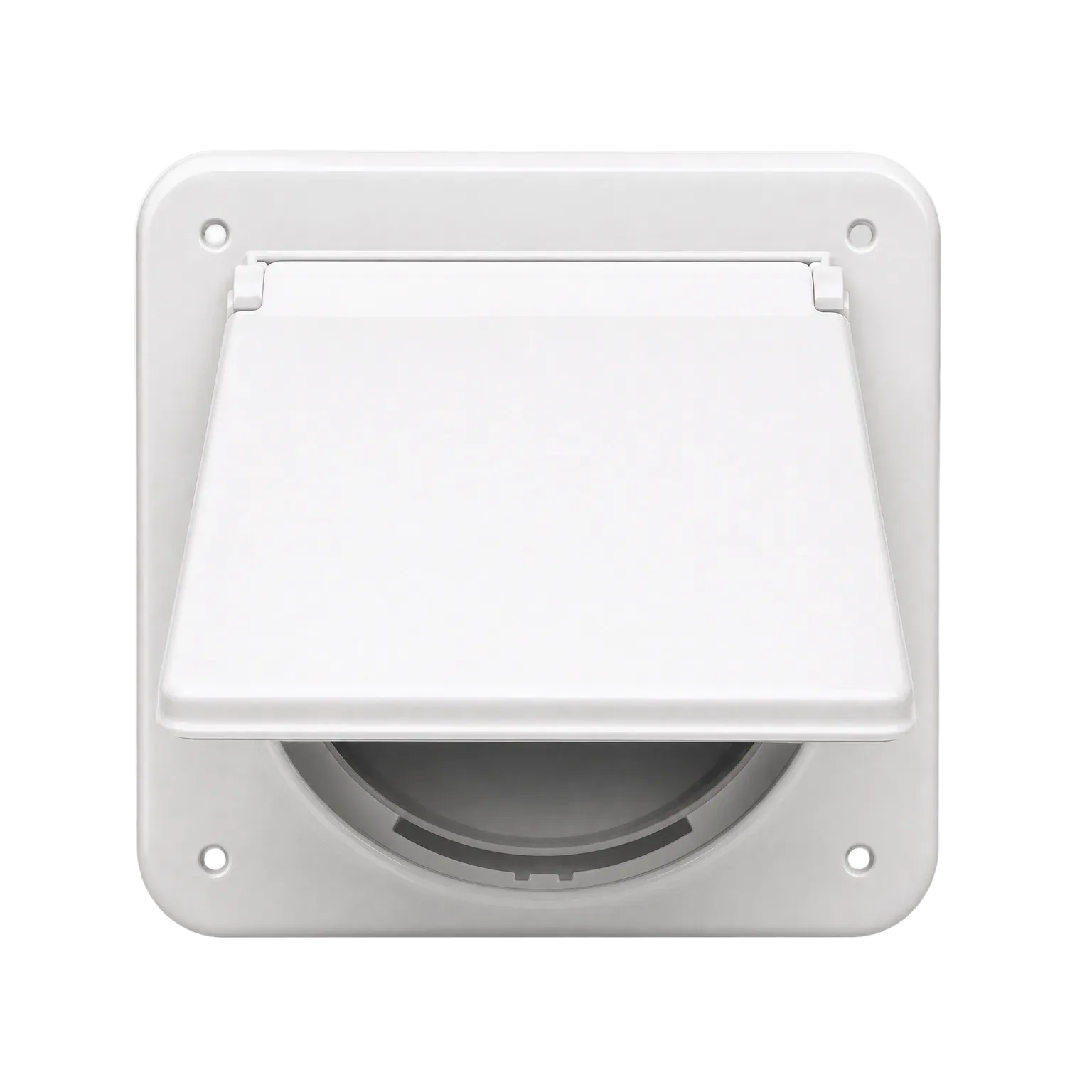

The vent cap sits open
Air moves freely through the louvers and the flap swings loose when the dryer kicks on. This is what a clear vent looks like from outside, mounted flush against the siding with nothing blocking the opening.
A clogged dryer vent shows up first as clothes that take two or three cycles to dry when one used to do it. The top of the dryer feels hot to the touch, or the laundry room warms up while it runs. You might notice less lint in the trap than usual, not more, because the lint is catching further down the line instead of on the screen. Outside, the vent hood flap stays shut or barely moves when the dryer is going, and that's a clear sign air isn't getting through. A burning smell points to lint sitting against the heating element. None of this is just an inconvenience. A blocked vent makes the dryer run hotter and longer to do the same job, and with Michigan winters pushing everyone's gas and electric bills up already, a dryer working against a clog adds a cost you don't need. Left alone long enough, the heat and trapped lint are a fire risk.




A dryer vent is supposed to carry hot, wet air straight out through the hood on the outside wall. When lint narrows that path, the air backs up into the duct and the drum instead of leaving the house. The dryer does not stop working. It just works harder, running longer to get clothes dry and pulling more power to do it. Go outside while a load is running and watch the hood. The flapper should swing open with the airflow. If it barely lifts, something is blocking the line between the dryer and that hood, and it is usually not right at either end. Lint tends to catch where the duct bends or joins another section, building up there long before it narrows the straight runs. If lint collects near the heating element instead of making it to the trap, it can scorch, and that is what you are smelling if a burning odor shows up mid-cycle. Some dryers have a high-limit thermostat that will cut the cycle short when heat has nowhere to go.


A dryer that runs long and hot is pushing moist air somewhere it shouldn't go. That moisture settles in the duct, behind the wall, or back into the room with nowhere to vent out.
Lint and moisture together are what catch fire. A vent that takes three cycles to dry a load is already telling you the airflow isn't getting outside the way it should.


Skip calling around for someone who cleans dryer vents.
There's no charge for the request.

Air moves freely through the louvers and the flap swings loose when the dryer kicks on. This is what a clear vent looks like from outside, mounted flush against the siding with nothing blocking the opening.

When lint builds up faster than it clears, it backs up to the outside cap and starts showing through the louvers. If you can see lint from the yard or driveway, the duct behind that cap is worse than what you're looking at.

Every load that takes three cycles instead of one is running your dryer that much longer on power that costs more here than in most states. That adds up across a year of laundry for a household, not just one wash day. Meanwhile the moisture that should be venting outside is landing somewhere in your house instead, in the duct, behind the wall, or in the laundry room itself, and with Michigan summers already sticky, that extra moisture has fewer places to go and takes longer to dry out on its own.
Tracking down someone who services dryer vents, explaining the symptoms, and sorting through quotes is its own chore on top of the laundry pile. Answer a few questions about your house and what you're seeing and you get matched with a contractor who handles vent cleaning in your area, and they'll reach out to you directly. No calling around, no repeating yourself to five different companies.


The flap swings loose when the dryer runs, and the louvers stay open between loads. Air from the drum pushes straight out through the hood with nothing in the way. A vent cap mounted like this on the siding means the duct behind it is doing its job.

The flap sits propped open by lint that has built up behind it, not by airflow. Gray lint fills the opening instead of passing through it. A vent cap looking like this means the duct behind the wall is likely coated the same way, end to end.
At 20.03 cents a kilowatt-hour, every extra cycle a clogged vent forces costs you more here than it would almost anywhere else. A dryer that needs three runs instead of one is burning that rate three times over, load after load, all year.
EIA-861 2025 statewide residential average
Put it together and the pattern is clear. A dryer that needs two or three cycles, a hot top, a warm laundry room, a vent cap that won't swing open, a trap with less lint than you'd expect. None of those are separate problems. They are one problem, a vent that air can't get through, showing up in different places around the house.
What they don't tell you is how bad it is back in the duct. That's not something you can see from the trap or the vent cap outside. It takes someone opening it up to know whether this is a quick clean or a duct packed solid.
Here in Michigan, with power running over 20 cents a kilowatt-hour, those extra cycles are not a small thing to let ride. Every load that runs three times instead of once is burning that rate three times over, and it keeps doing that until the vent is cleared.
Normally, getting to that point means finding a few companies, calling each one, explaining the same thing about the hot dryer top and the slow drying times, then sitting with a stack of quotes trying to figure out who actually knows what they're doing. Matching with a contractor skips past that part. Instead of you doing the legwork, someone who handles this gets your information and reaches out to you directly. You still need the vent looked at. You just don't have to be the one chasing down who's going to do it.

Answer a few questions about the dryer vent cleaning and skip the search.