



Signs your air ducts need cleaning in Michigan

A local pro who cleans ducts gets in touch with you.

Connect with a pro

Dust coming back within a day or two of cleaning, musty air when the furnace or AC kicks on, and more sneezing indoors than out are the usual signs your ducts need attention. You might also see dark streaks around the vent covers, or notice some rooms barely get airflow while others feel fine. In Michigan, the furnace runs for months straight, so anything sitting in the ductwork gets stirred up and pushed through the house over and over. Then summer comes and the AC pulls the same air through, which is why a lot of people notice it most when the weather turns sticky. If you can see dust building up on vent covers within a week of wiping them down, that is not normal and it usually means the ducts themselves are holding onto more than they should. None of this is about one bad day of allergies. It is about what keeps happening every time the system turns on.

Unfinished basement interior with exposed wooden floor joists, galvanized rectangular and round sheet-metal ducts, a gray furnace unit at left, and a large blank light-colored wall at right.

Why humidity makes it worse

Michigan summers run sticky, and that moisture gives dust and debris inside the ducts something to cling to instead of blowing through. A system that would stay fairly clean in a dry climate collects more buildup here over the same months. If the musty smell shows up mainly when the air conditioner is running, that is the moisture in the ducts reacting with what is already sitting in them.

Galvanized sheet metal ductwork with elbows and a vent grille running beneath an exposed wood joist and OSB ceiling, next to a blank white wall.

What the vent covers tell you

Pull a vent cover off and look at the inside edge of the duct, not just the grille. A thin gray film is normal. A thick, felt-like layer, or dust that falls out when you tap the duct, means air is dragging debris loose every time the system runs. Check a return vent too. Returns pull air out of the room and often show buildup before supply vents do.

Why does the dust keep coming back

Run a finger along a vent cover and check it again after a couple of days. If it's dusty that fast, or you're wiping down shelves more often than you used to, the ducts are probably feeding it back into the room. A musty smell when the furnace kicks on points the same direction. So does a room that never seems to get enough air, even with the vent wide open. Some households notice more sneezing or stuffiness indoors than out, which usually means whatever is sitting in the ducts is getting stirred up and breathed in every time the system runs. None of this is dramatic on its own. Left alone, it just means the air moving through your house all winter and all summer is carrying more than it should.

Unfinished basement with galvanized sheet-metal rectangular and round ductwork running along a wood-joist ceiling, two steel support columns, a small window, and a furnace unit against the far right wall.

Ducts doing their job

Air moves through the metal trunk lines and out to each room without much resistance. Vents stay fairly clean between dustings, and a room at the far end of the house still gets warm or cool within a few minutes of the furnace or AC kicking on.


An unfinished basement with bare concrete walls and floor, showing exposed wooden floor joists, pipes, wiring, and metal HVAC ducts with a vent grille overhead.

Ducts losing the fight

The same run of ductwork is working harder than it should. Branch lines near the joists are coated inside, and the plenum box is feeding dust back into the rooms it serves. One or two rooms lag behind the rest of the house no matter how long the system runs.

Normal Dust or Ducts Feeding It Back

Normal dust load

  • A dusting schedule you can predict, shelves need a wipe about once a week and not sooner.
  • Vent covers show a thin film after several days, not a heavy coat after one.
  • Nobody in the house is sneezing more indoors than they do out in the yard.
  • Air coming out of the vents smells like nothing, not like a damp basement.
  • Allergy symptoms stay about the same whether the furnace or AC is running or off.

Ducts feeding it back

  • Shelves and vent covers are dusty again within a day or two of being cleaned.
  • The air smells musty the moment the furnace or AC kicks on, then fades.
  • Someone in the house is sneezing more indoors than they do outside.
  • Dark streaks show up around the vent covers even after they've been wiped down.
  • One or two rooms stay noticeably warmer or cooler than the rest no matter the setting.
A smiling gray-haired man in a dark wool coat with snow flecks stands in a dimly lit home entryway, with a lit table lamp, potted plant, framed pictures and a living room visible behind him.
An older man with gray hair and a beard, wearing a snow-dusted dark coat and knit scarf, stands smiling in a dimly lit house entry with a lit lamp, mirror, and a living room with snow visible through the window behind him.
An older man with gray hair and a beard, wearing a dark snow-dusted coat and plaid scarf, stands smiling in a warmly lit hallway with a lamp, side table and glass-paned doors behind him.
An older man with gray hair and a beard, wearing a dark coat dusted with snow, stands in a home entryway with a lit lamp, a staircase railing, and a living room with large windows behind him.
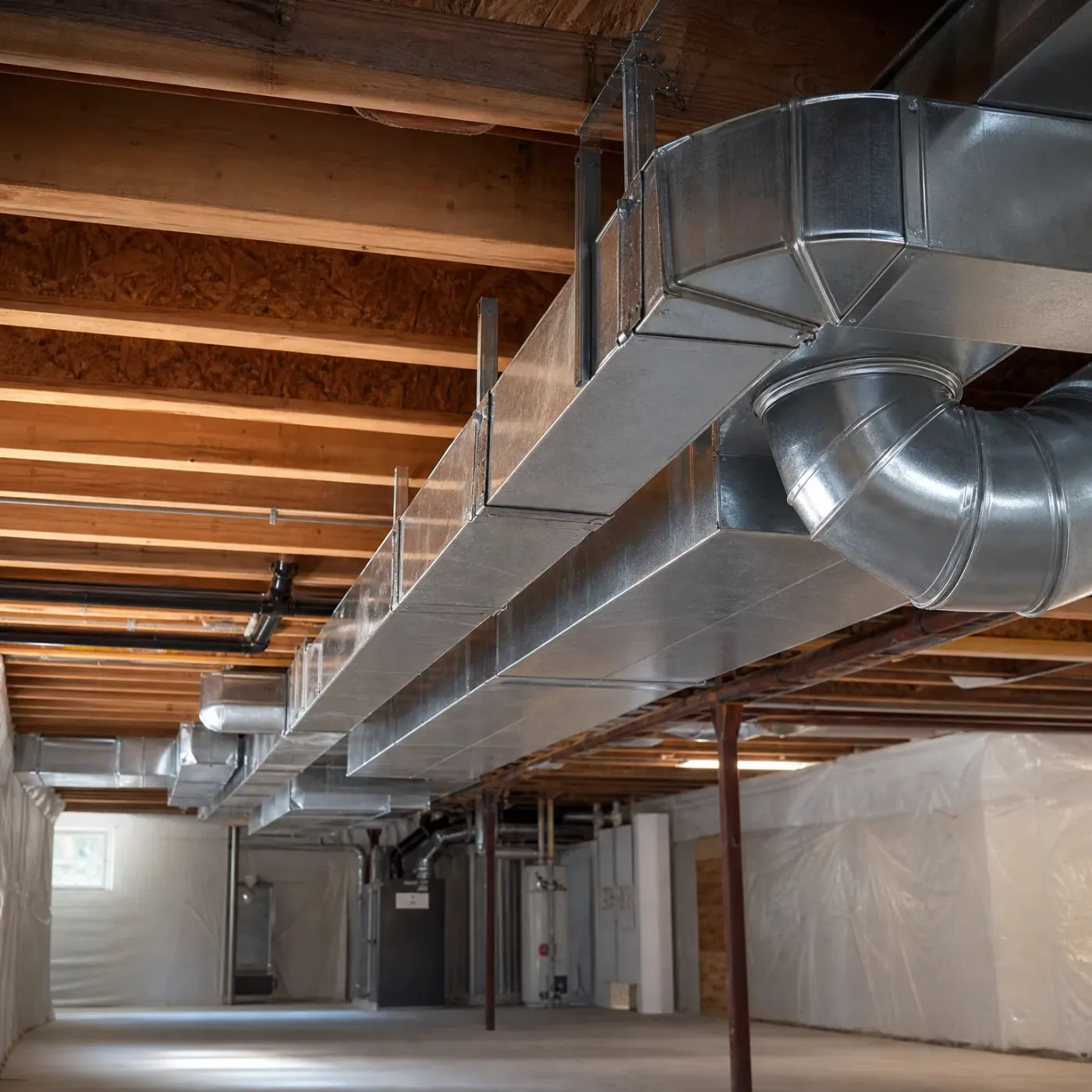
Unfinished basement with galvanized sheet-metal trunk ductwork and round branch ducts suspended beneath wood floor joists, with support posts, plastic sheeting on the walls, and a furnace and water heater along the far wall.

A duct system pro near you

Send the form and finding a duct cleaner is handled.

Say what's going on with your ductwork, and a pro who works on them reaches out.

Find a pro near me

You only hire the pro if you want to.

Unfinished basement with bare concrete walls and floor, showing exposed wood floor joists overhead with sheet-metal rectangular ductwork, insulated flexible ducts, and pipes.
Sheet-metal trunk lines and flex duct run clean and tight between the joists, with no dust ringing the seams.
Basement ceiling with galvanized sheet metal rectangular ducts and round pipes running between wooden joists above a bare concrete wall and floor.
Dust has built up heavy enough along the trunk lines and flex duct to leave visible streaks across the metal.

How does cleaning actually get the dust out of my ducts?

You've seen what the signs mean, but it's fair to wonder what actually happens inside the ductwork once someone shows up to clean it. It's not just a vacuum run along the vent covers. The dust and debris sitting along the trunk lines and flex duct has to be knocked loose first, then pulled out before it has a chance to resettle somewhere else in the system.

A vacuum pulls air through the whole system while tools knock the dust loose

A contractor connects a high-powered vacuum to the duct system, usually at the main trunk line, so it's pulling air through the whole run while the work happens. Then brushes or air whips get fed into each duct to knock loose what's settled along the walls, the dust that's built up worse here thanks to Michigan's muggy summers. As it's knocked free, the vacuum is already pulling it out through the system rather than letting it drop and resettle somewhere else in the ducts. Each vent and trunk line gets gone over this way before the registers go back on. Done right, it's the suction running the whole time that keeps loosened dust from just moving to the next section down the line.

Empty concrete-walled basement room with galvanized rectangular and round HVAC ducts and pipes running along the exposed wood-joist ceiling.
Before you get your ductwork cleaning
Unfinished basement with galvanized sheet-metal ductwork and pipes beneath wood joists, a gray furnace unit at left, insulated plastic-covered walls over a concrete foundation, and a bare concrete floor.
After you get your ductwork cleaning

Power costs 20.03 cents per kilowatt-hour statewide

At 20 cents a kilowatt-hour, a furnace blower or AC fan working harder to push air through clogged ducts shows up fast on your bill. Clean ducts let the system move air without straining, so you're not paying extra every month just to get the same heat or cooling.

EIA-861 2025 statewide residential average

What the Signs Add Up To

  • Dust that resettles in a day, musty air from the vents, and extra sneezing indoors are the signs that add up to one answer.
  • Sticky Michigan summers make buildup worse, so ducts here often need attention sooner than they would in a drier state.
  • A dusty vent cover, dark streaks near the registers, and a room that never seems to warm or cool right all point the same direction.
  • Once you send the form, you're done hunting for someone to call and a contractor reaches out to you instead.
  • Clean ducts stop costing you extra on a power bill already priced at 20 cents a kilowatt-hour.
  • Catching these signs now means a gas furnace and AC that don't have to work harder than they should.

A vent cover that's dusty again within a day, a musty smell when the furnace or AC kicks on, more sneezing inside than out, dark streaks near the registers, a room that won't warm or cool like the rest of the house. Any one of these on its own might mean nothing. A few of them together mean the ducts are carrying more than air. Michigan's sticky summers give dust and debris something to cling to, so homes here often reach this point sooner than they would somewhere dry. None of it is a guess you have to make alone. Once you send the form, the search is over. You're not the one calling around for someone who does this work. A contractor who handles duct cleaning gets in touch with you, and from there it's their job to look at what's actually built up inside your trunk lines and flex duct. In the meantime, the ducts keep working, or straining, every time the furnace or AC runs. At 20 cents a kilowatt-hour, a blower or fan pushing against clogged ductwork is money spent to get the same heat or cool air a clean system would deliver without the extra effort. Catching the signs now, the dust, the smell, the uneven rooms, means the system stops working harder than it has to, and the bill stops covering for it.

Dimly lit interior showing galvanized sheet-metal HVAC ductwork running below a wooden joist ceiling above a dark gray wall.

A local pro for your ductwork cleaning

One request and the duct cleaning stops waiting on you.

Duct and vent cleaningDucts or ventsMichigan
Step 1 of 2

What ZIP code is the job in?