Signs of leaky ductwork in Grand Rapids, MI

Get matched with a Kent County pro who cleans ducts.

Find a pro near me

A few things point to leaky ductwork. Some rooms stay warmer or cooler than others no matter where you set the thermostat. Your furnace or AC runs longer to reach the temperature you want, and your gas and power bills climb even though you haven't changed how you use the system. You might find dust settling faster than it used to, or notice the ducts in your attic or crawl space feel warm or cool to the touch when they shouldn't. Ducts leak at the seams and joints, where sections connect, and that connection loosens over the years. In a Grand Rapids winter, heated air escaping into an attic or crawl space means your furnace works harder to keep the house warm, and in a muggy summer the same gaps let humid air in around the cooled air trying to get out. Either way, you're paying to condition air that never reaches the rooms you live in.

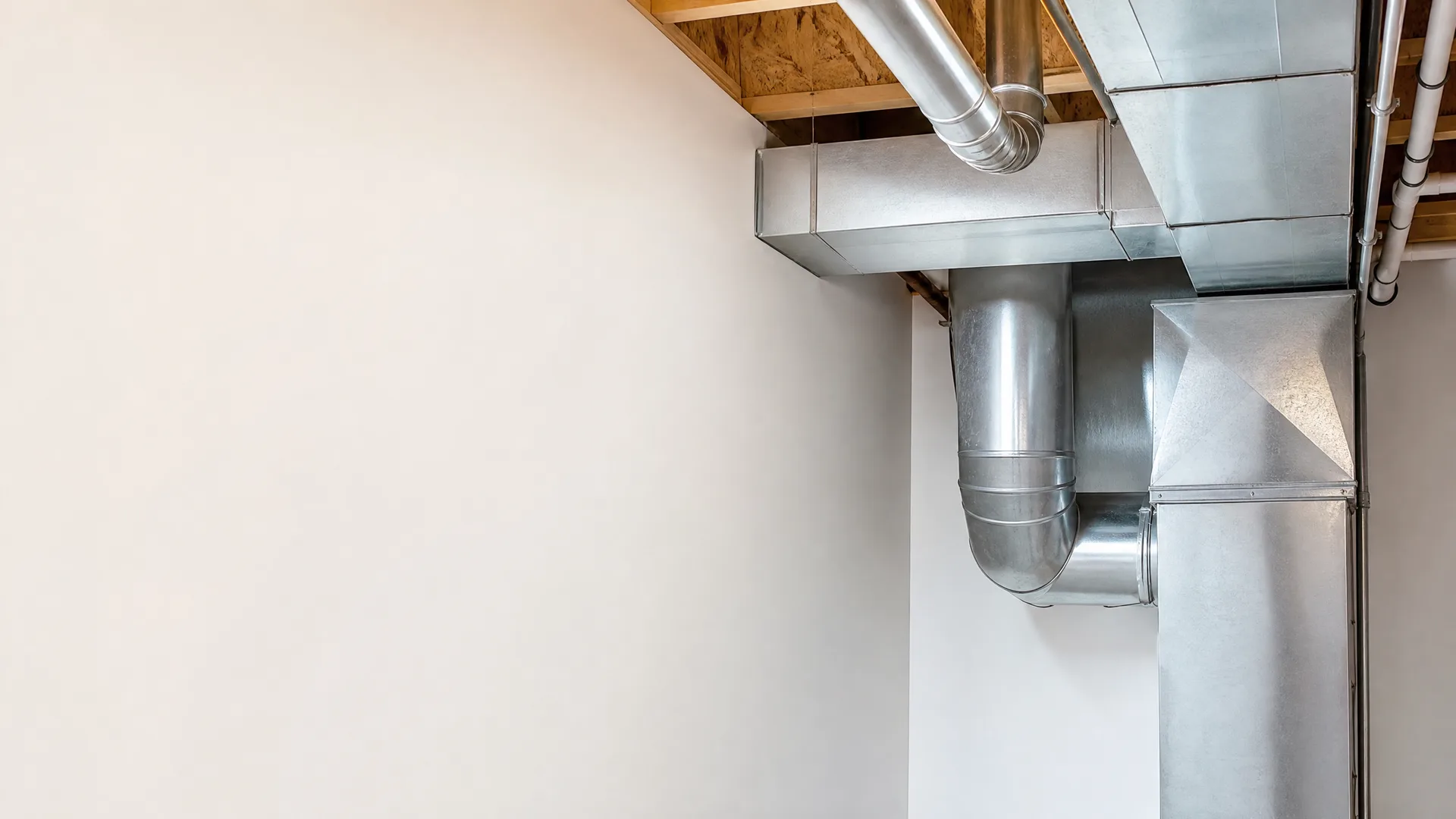
Galvanized sheet-metal ductwork and pipes running along an unfinished basement ceiling beside a plain beige wall, with a gray equipment cabinet below.

Where the air actually goes

Ducts run through the attic, the crawlspace, and the basement before they ever reach a room register. A seam that's come apart in any of those spots lets heated or cooled air spill out before it gets where it's supposed to go. That's why a bedroom at the far end of the house can lag behind the rest while the thermostat reads the temperature near where it's mounted, not where you're sitting.

Galvanized sheet metal rectangular and round HVAC ducts running along a ceiling and down a white interior wall, with exposed wood joists and subfloor above.

Dust is a clue, not a nuisance

Leaky return ducts pull air from attics and crawlspaces instead of the rooms you live in, and that air carries dust and insulation fibers into the system. If you're dusting registers and surfaces more often than you used to, or you notice a musty smell when the furnace or AC kicks on, that's the duct system drawing in air from somewhere it shouldn't.

Does one room never feel right?

Walk through your house with your hand near each vent. If one feels like a trickle next to the others, that's air leaving the duct before it gets there. Check the room behind it. A bedroom over the garage or a room at the end of a long duct run that's always a few degrees off, warmer in summer, colder in winter, points the same way. You might hear a faint hiss near a duct joint in the basement or attic, or notice the air coming from a vent feels weaker than it used to. Dust around a register or a musty smell when the system runs can mean the duct is pulling air from a crawlspace instead of the room. Left alone, the furnace and AC keep working harder to cover the loss, and that shows up on your gas and power bill before much else does.

An empty unfinished basement with concrete floor and walls, exposed wood joists, steel beams and support posts, galvanized ductwork and pipes, and a single bare bulb light.

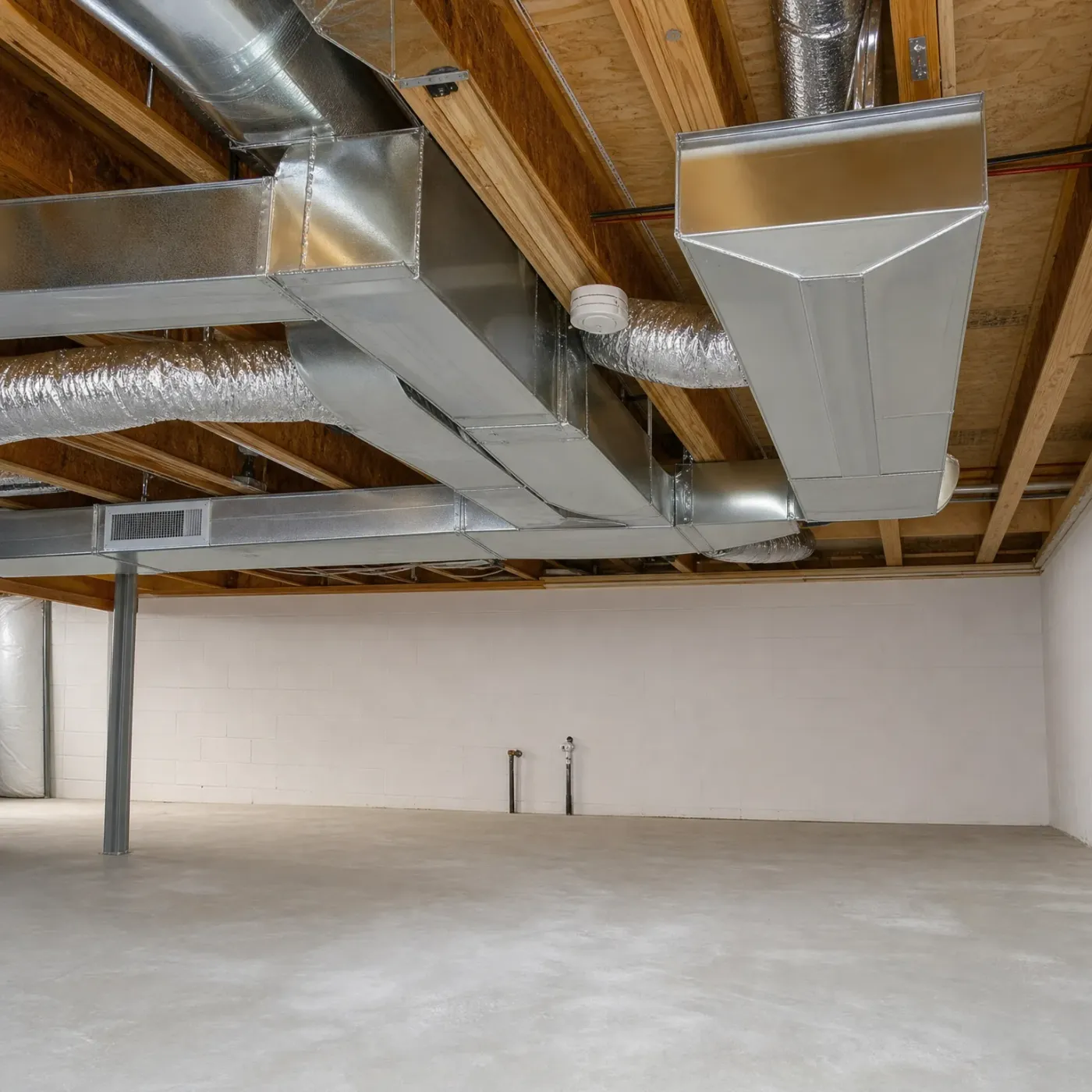
Ductwork run tight

This is what a sound duct system looks like from the basement. Sheet-metal trunk lines and flexible runs cross between the joists, joints snug, metal clean. Air moves through to the registers without finding a way out along the way.

Empty basement with bare concrete walls and floor, with galvanized sheet-metal HVAC ducts, a round duct elbow, and pipes running along the wooden joists of the ceiling.

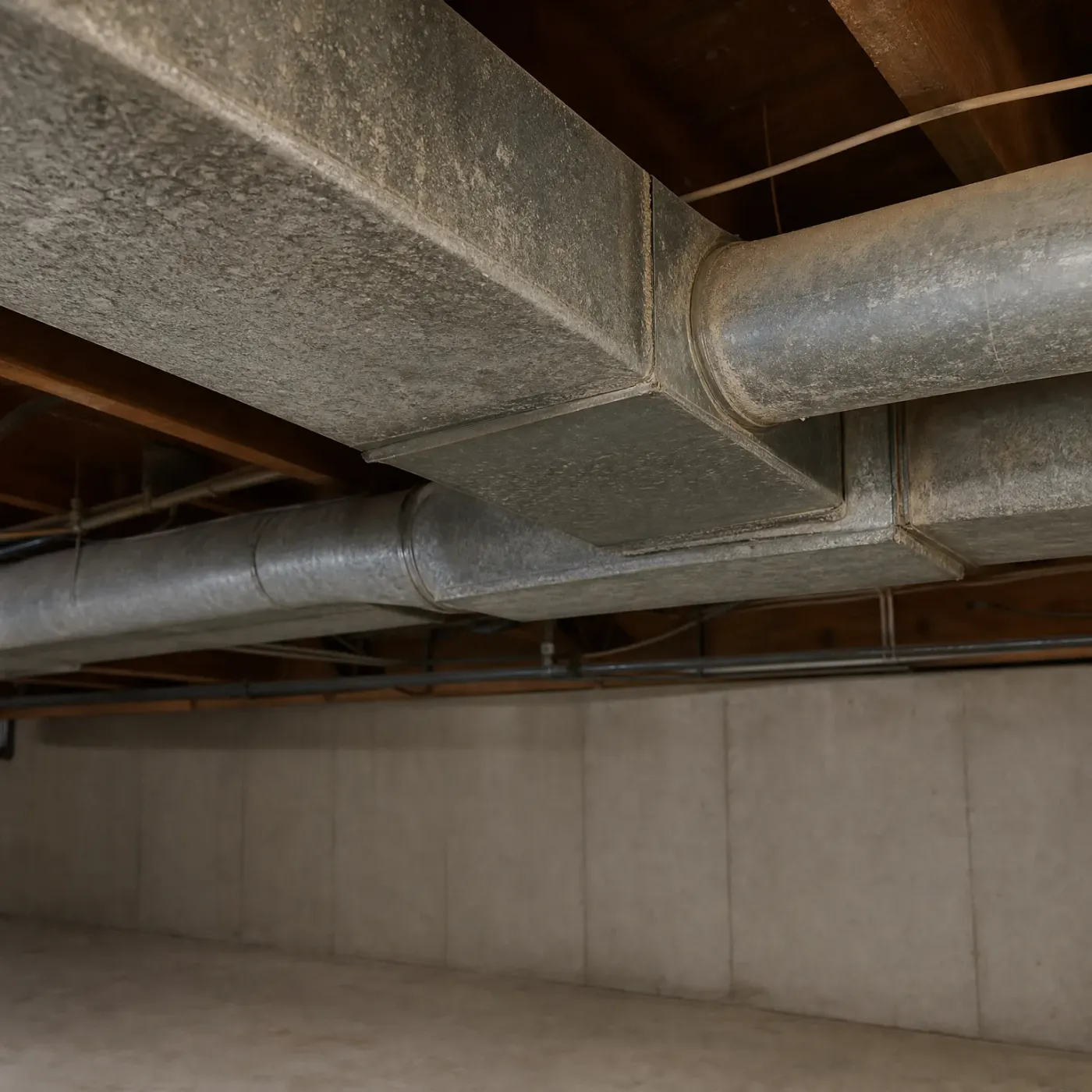
Ductwork in trouble

Here the duct run shows it. Dark staining spreads across the joists and the metal itself, left by moisture that's been riding along with air escaping a loose seam. A duct sweating like that is losing conditioned air right where you can't see it.

Why does leaky ductwork matter so much for your house?

  • Half the homes here were built by 1977

    Half the homes in Kent County were built in 1977 or earlier, and duct joints that old have had decades to work loose or pull apart at the seams.

  • Heat runs October through May

    Heat runs October through May here, eight months of the year pushing air through those ducts and out any gap that's opened up along the way.

  • Cooling runs June through August

    Cooling runs June through August, three more months of conditioned air finding its way into the attic or crawlspace instead of your rooms.

ACS 2020-2024 · NOAA nClimDiv 1991-2020

A dim room corner with a dark grey sofa and cushion, a wooden side table holding a ceramic vase and a small potted plant, a linen curtain beside a bright window, and a wall vent near the ceiling.

The sun's been up a few hours and it's coming in low across the living room. You notice it because the light catches the ceiling vent just right, and you can see the dust sitting on the grille, thicker than it should be for how often you run the furnace this time of year. Then you look down at the end table under it, and there's a fine gray film on that too, the kind that comes back a day after you wipe it. You didn't open a window. You haven't had the fireplace going. It's just what's been moving through that duct and settling here instead of wherever it was supposed to end up.


Duct Cleaning vs. Sealing

Duct cleaning

  • A contractor clears dust, pet hair, and debris sitting inside the trunk lines and runs so the air moving through is cleaner.
  • It won't stop air from escaping through a torn seam or a joint that's pulled apart.
  • If a register barely puffs air, cleaning the duct won't change that if the real problem is a leak upstream.
  • Cleaning doesn't touch your gas or power bill if the cause of the high bill is conditioned air leaking into the attic or crawlspace.
  • Worth doing on its own schedule, separate from whatever is causing uneven temperatures room to room.

Duct sealing or repair

  • A contractor seals the seams and joints where air is actually escaping, so more of what your furnace or AC makes reaches the rooms.
  • This is what closes the gap between one room running warm or cold and the rest of the house holding steady.
  • It addresses the furnace or AC running longer than it should to hit the temperature on the thermostat.
  • Sealing targets the specific leak, whether that's in the attic, the crawlspace, or the basement, rather than everything in the system at once.
  • Won't remove dust already built up inside the ducts; that's a separate job.
An older man with gray hair and a beard, wearing a dark jacket dusted with snow, stands smiling in a dimly lit hallway with lamps and a living room visible behind him.
A gray-haired, bearded man in a dark snow-dusted coat stands smiling in a dimly lit entry hall with a staircase, a lit table lamp, a framed picture, and a living room visible through a doorway.
An older man with white hair and a beard, wearing a dark snow-dusted coat and scarf, stands in a warmly lit interior hallway with a framed landscape picture, a table lamp and a potted plant behind him, and a snowy view through a window at left.
A gray-haired, bearded man in a dark coat dusted with snow stands smiling in a dimly lit room with a lamp, mirror, framed art, and a sofa in the background.

Get matched with a duct system pro in Kent County

Send the form and finding a duct cleaner is handled.

Asking costs nothing, and the choice to hire stays yours.

Empty basement with bare concrete floor, painted block walls, and an exposed wood-joist ceiling with sheet-metal and insulated flexible ductwork and a steel support column.

Ductwork run tight

This basement shows a system working the way it should. Trunk lines and flexible runs cross cleanly between the joists, joints snug against each other. Air moves from the furnace to the registers without finding a gap to slip through along the way.

Galvanized rectangular and round sheet-metal ductwork running beneath a wood-joist ceiling in a basement with concrete walls and floor, with pipes and wiring alongside.

Ductwork losing air

This trunk line is coated in dust and grime, heavier than normal use would leave behind. That buildup settles where air is escaping the seams before it reaches the branch duct, not just passing through a clean system on its way to a room.

How can you tell if it's your ductwork and not just dust?

Dust on the grille and dust in the ducts aren't the same problem, and it matters which one you have before you call anyone. One points to a cleaning. The other points to a seam that's pulled apart somewhere behind the wall. A homeowner can tell the difference without opening anything up, just by paying attention to what the air itself is doing.

Dust settles anywhere. Air loss shows up as a room that won't hold temperature.

A dusty grille just means the filter isn't catching everything, and a cleaning handles that. A leak shows up differently. Hold your hand near the register in the room that bothers you most. If the airflow feels weak compared to other rooms on the same floor, that's air leaving the duct somewhere between the furnace and that register. Check your energy bill too. Dust doesn't raise it. A duct leaking conditioned air into the attic or crawlspace does, because your furnace or AC has to run longer to make up for what never arrives. If the weak airflow and the higher bill show up together, that's ductwork, not dust.

Empty unfinished basement with concrete walls and floor, exposed wood joists, metal HVAC ducts and pipes overhead, and a steel support column near a framed wall.
Joints fit snug here, so the air making it to the furnace stays inside the metal the whole way.
Empty basement with bare concrete walls and floor, a steel support column, and galvanized sheet-metal ductwork and pipes running along the exposed wood joist ceiling.
Same kind of run, but a seam has pulled apart, and conditioned air is spilling into the basement instead of your rooms.
  1. Air leaves the furnace or AC under pressure through the trunk line.

  2. Branch runs carry that air toward each room's register.

  3. A pulled seam or loose joint lets air escape into the attic, crawlspace, or basement.

  4. The register puffs weak air because less of it finished the trip.

Galvanized sheet-metal ductwork and round pipes run along a wooden floor joist ceiling above a bare concrete wall and floor.
Before you get your ductwork cleaning
Unfinished basement with concrete floor and walls, exposed wood joists, steel support posts, and large galvanized sheet-metal ductwork running to a furnace or air handler against the far wall.
After you get your ductwork cleaning

Power here costs 20.54 cents per kilowatt-hour

At that rate, air your furnace or AC already paid to heat or cool is expensive to lose through a gap in the duct. A seam that's pulled apart doesn't just waste comfort, it waste cents you're spending on every kilowatt-hour.

EIA-861 2025

What the Signs Add Up To

  • Uneven rooms, a furnace that runs long, and climbing bills together point to ductwork, not just dust on a grille.
  • A weak register, a dusty vent, or a warm room over the garage each tell you something different about where the leak sits.
  • None of this calls for guesswork on your part once you know what to check and where.
  • Sending the form hands the search for a contractor off to someone else, so it's one less thing on your list.
  • A sound duct run keeps the air your furnace already heated inside the metal all the way to the register.
  • Fixing a pulled seam stops the waste at its source instead of just covering for it room by room.

A room that won't hold temperature, a furnace that runs longer than it used to, a gas bill that's climbed for no reason you can name. Taken together, these point past the filter and the grille to the ductwork itself. A trickle of air at one register tells you where to look. Dust thick on a vent tells you something else entirely, and it's worth knowing the difference before you decide what you're dealing with. None of this requires you to guess. Walk the vents, feel for the weak one, check what room sits behind it, and you'll know more than most homeowners do before a contractor ever sees the place.

What you're looking for is simple even if the duct run isn't. Sound ductwork keeps the air your furnace just spent gas heating inside the metal, seam to register, with nothing lost along the way. A pulled joint in the attic or crawlspace lets that same air spill out before it reaches the room it was meant for, which is why the fix has to happen at the seam and not at the vent. Sealing it stops the loss where it starts instead of asking your furnace to run longer to cover for it.

Once you've spotted the signs, the next step isn't tracking down who in Grand Rapids handles this kind of repair. Send the form, and that search becomes someone else's job instead of yours.

Dim interior with a dark gray wall, exposed wood joist ceiling, sheet-metal ductwork, conduit, pipes and a sprinkler head.

A pro who works on ducts

One request and the duct cleaning stops waiting on you.

Duct and vent cleaningDucts or ventsKent County, MI
Step 1 of 2

What ZIP code is the job in?