Mini Split Installation in Saginaw, MI
A new system here will heat from October through May and cool from June through August every year. Tell us about the house, and a licensed contractor who covers Saginaw County will get in touch.
Tell us about the job
It takes about a minute.
What a mini-split here has to handle
Saginaw County needs heat eight months of the year, October through May. Winter nights average 19°F. A mini-split has to hold its heating output at temperatures well below freezing, night after night, for most of the year. Summer is short by comparison, just June through August, with afternoons around 81°F. The cooling side of the job is real but not the main event.
A new mini-split installed here has to meet the federal minimum for a split-system heat pump if it was built on or after January 1, 2023. That means 14.3 SEER2 for cooling and 7.5 HSPF2 for heating. Worth asking about too. Power in Michigan goes out for 24 hours or more in a third of households in a given year, and this area has logged 13 winter storms and 79 damaging wind events over the past decade. A mini-split that loses power loses heat until it comes back.
- 8 months
- October through May, your system heats
- 3 months
- June through August, it cools
- 19°F
- the average winter night it heats against
- 81°F
- the average summer afternoon it cools against
NOAA nClimDiv, 1991–2020 normals
Michigan requires HVAC contractors to hold a state license.
The Board of Mechanical Rules issues that license to the contractor, not to any single job, so the same license covers this install and whatever work they take on next.
For a mini-split, that license is what stands behind the person doing the work. On top of it, most cities and counties in Michigan require a permit from the local building office before the work starts, with an inspection once it's done. The permit and inspection are what catch a line set that was not run right or a connection that was not sealed. The license tells you who is doing the work. The inspection tells you it was done right.
Sources: Michigan Legislature · Michigan Department of Licensing and Regulatory Affairs
- Is a mini split worth it?
- For the right room or setup, yes. A mini split heats and cools without ductwork, and it puts a thermostat right in the room instead of relying on one sensor for the whole house. Homes here need heat October through May and cooling only June through August, so a mini split rated for cold climates has to carry that load, and a good one can hold a room through a 19°F night without much trouble. Whether it makes sense for your house depends on what you're heating now and how the space is laid out, and a contractor can walk through that with you.
- How many rooms can a mini split cover?
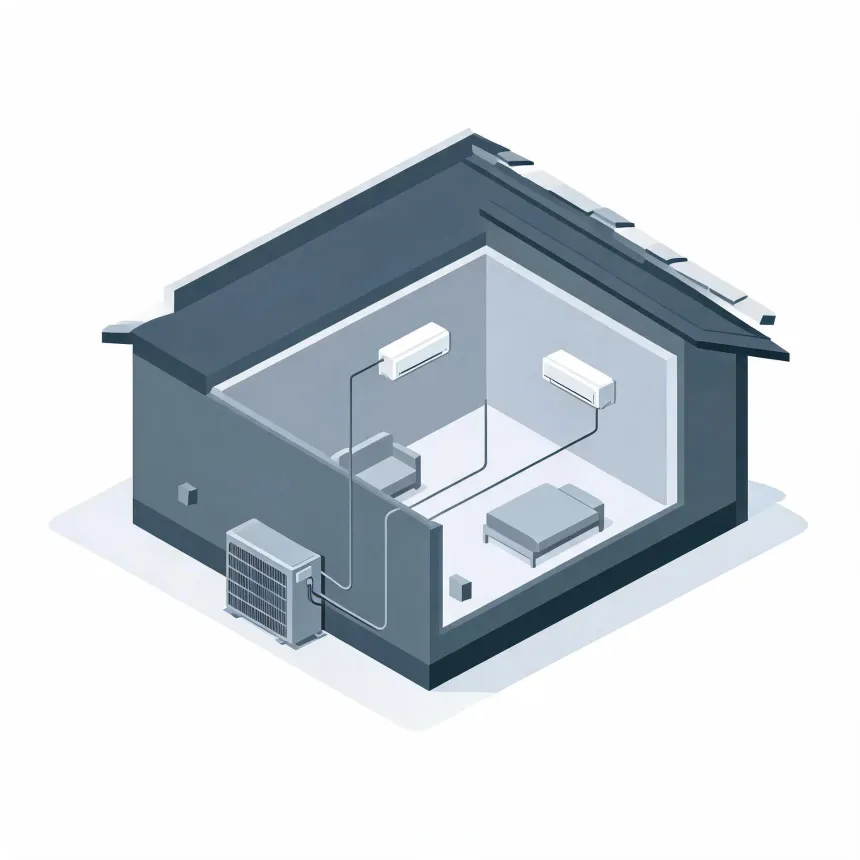
- One outdoor unit can run several indoor heads at once, each one set to its own thermostat in its own room. The more heads you add to one outdoor unit, the more the total capacity gets divided among them. So a contractor sizes the system to the square footage and layout of each room, not just the number of rooms you want covered.
- Can a mini split heat a whole house?
- It can, if a head is placed in every room and the system is sized for the house. Cold-climate mini splits are built to keep producing heat well below freezing, which matters here since winter nights average 19°F from December through February. The harder part is coverage, not cold. A room with no head in it stays cold no matter how well the rest of the house is heated, so a contractor needs to see the floor plan to say how many heads the house would need.