Mini Split Installation in Kalamazoo, MI
A new system here will heat from October through May and cool from June through August every year. Tell us about the house, and a licensed contractor who covers Kalamazoo County will get in touch.
Tell us about the job
It takes about a minute.
What Kalamazoo winters ask of a mini-split
Your mini-split needs to work here from October through May, eight months of the year. Winter nights average 19°F, so the heat pump has to keep pulling warmth from air that cold most of the winter. Summer afternoons average 81°F, a milder job by comparison. Most homes here still heat with gas, so a mini-split added to one room, or to a space with no ductwork, is often carrying those cold nights on its own.
Any unit installed new has to meet the federal minimum for a split-system heat pump, 14.3 SEER2 for cooling and 7.5 HSPF2 for heating. That is the floor, not a feature to ask for. Nearly a third of Michigan households lost power for at least a day at some point in 2024, so it is worth asking your contractor how the system comes back once power returns.
- 8 months
- October through May, your system heats
- 3 months
- June through August, it cools
- 19°F
- the average winter night it heats against
- 81°F
- the average summer afternoon it cools against
NOAA nClimDiv, 1991–2020 normals
Michigan requires HVAC contractors to hold a state license.
The Board of Mechanical Rules issues that license, and it covers the contractor as a whole, not the individual job on your property. That contractor's license is what stands behind the work when the crew is in your home running lines for the mini-split.
In most cities and counties, installing a mini-split also needs a permit from the local building office, with an inspection once the work is done. That inspection is separate from the license. It is what catches a bad line set or a bad electrical connection after the contractor has already left.
Sources: Michigan Legislature · Michigan Department of Licensing and Regulatory Affairs
- Is a mini split worth it?
- For the right space, yes. A mini split puts heat right where you need it without ductwork, which matters if you're heating a room that's always cold or adding space that the main system doesn't reach well. Cold-climate models are built to keep working at the low temperatures Kalamazoo sees in January and February, so winter performance here isn't a concern with the right unit. Whether it makes sense for your house depends on what you're trying to fix, so a contractor can look at the space and tell you what to expect.
- How many rooms can a mini split cover?
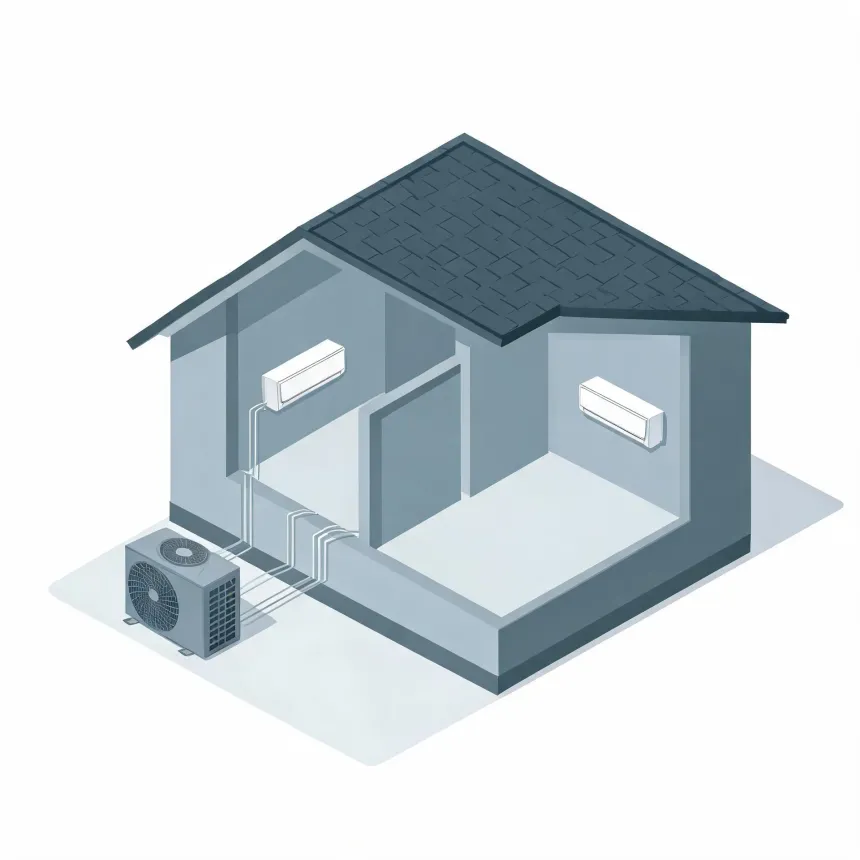
- A single outdoor unit can run one indoor head or several, up to eight on some multi-zone systems. Each indoor head is sized for the room it's in, so a system built for three rooms won't perform the same if you add a fourth later. The right number of zones comes down to the layout of the house and how those rooms are used, which is something a contractor needs to walk through with you.
- Can a mini split heat a whole house?
- It can, if the system is sized and placed for that. Homes here need heat from October through May, so a whole-house mini split has to keep up through real winter lows near 19°F, not just take the edge off. That means enough zones to reach every room and outdoor equipment rated for cold climates. A contractor can look at the house and work out whether a mini split alone covers it or whether it makes more sense paired with existing heat.