Mini Split Installation in Grand Rapids, MI
A new system here will heat from October through May and cool from June through August every year. Tell us about the house, and a licensed contractor who covers Kent County will get in touch.
Tell us about the job
It takes about a minute.
What a mini-split in Kent County has to handle
Your mini-split needs to heat from October through May and cool in June through August. That's 11 months a year one system has to cover, most of it heating. Winter nights average 19°F here, so the heat pump has to keep pulling warmth out of cold air for months at a stretch, not just on the odd cold snap. Summer afternoons average 81°F, which is a moderate cooling load by comparison.
Any new unit installed has to meet the federal minimum for split-system heat pumps, 14.3 SEER2 for cooling and 7.5 HSPF2 for heating. That standard applies whether the mini-split is replacing an old one or going into a room that never had one, and it has to be sized for a full winter here, not just the three summer months.
- 8 months
- October through May, your system heats
- 3 months
- June through August, it cools
- 19°F
- the average winter night it heats against
- 81°F
- the average summer afternoon it cools against
NOAA nClimDiv, 1991–2020 normals
Michigan requires HVAC contractors to hold a state license.
The Board of Mechanical Rules issues that license, and it is tied to the contractor, not to any single job. The state tested this person before handing it out, and it keeps a record of who holds one, but the license itself does not follow your mini-split to your wall. It follows the contractor from job to job.
For a mini-split installation, that license is what stands behind the person doing the work. Beyond that, most cities and counties in Michigan require a permit for this kind of installation, along with an inspection once it's done. The permit and inspection are a separate check, run by the local building office, not the state board. Between the two, one confirms who is doing the work and the other confirms the work itself was done right.
Sources: Michigan Legislature · Michigan Department of Licensing and Regulatory Affairs
- Is a mini split worth it?
- For most homes it comes down to what you're heating or cooling and how well the ductwork, if any, covers that space. A mini split handles a room or addition that your existing system can't reach without new ducts, and it heats efficiently even at low temperatures since it's a heat pump. Grand Rapids winters get down to 19°F on average overnight, so pair it with the right cold-climate model and a backup plan for the coldest stretches. Most homes here run gas heat already, so a mini split often works best as a way to cover one space well rather than replace the whole system.
- How many rooms can a mini split cover?
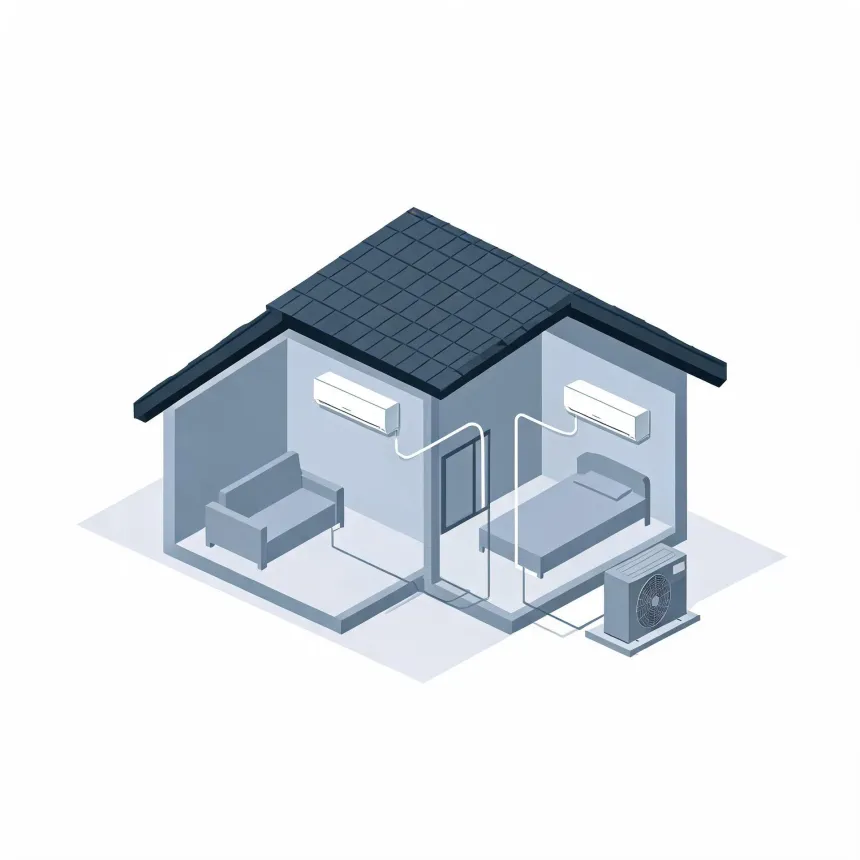
- A single outdoor unit can run one indoor head or several, up to eight on some multi-zone systems. Each indoor head is sized to the room it's in, so a bedroom and an open living area need different capacity even on the same outdoor unit. The more zones you add to one outdoor unit, the more a contractor has to balance capacity across all of them. For anything beyond a room or two, a load calculation on the house tells you what the outdoor unit needs to handle.
- Can a mini split heat a whole house?
- It can, but it takes the right number of zones sized for every room, not just one head in the living room. Homes here need heat from October through May, eight months a year, with overnight lows averaging 19°F in the coldest stretch, so the system has to be rated to keep up in that cold rather than just handle mild days. A contractor can run a load calculation on the house and lay out how many indoor units it would take to cover every room. For a lot of homes here, that means comparing a multi-zone mini split against the gas furnace already in place, since most houses in Grand Rapids heat with gas.